
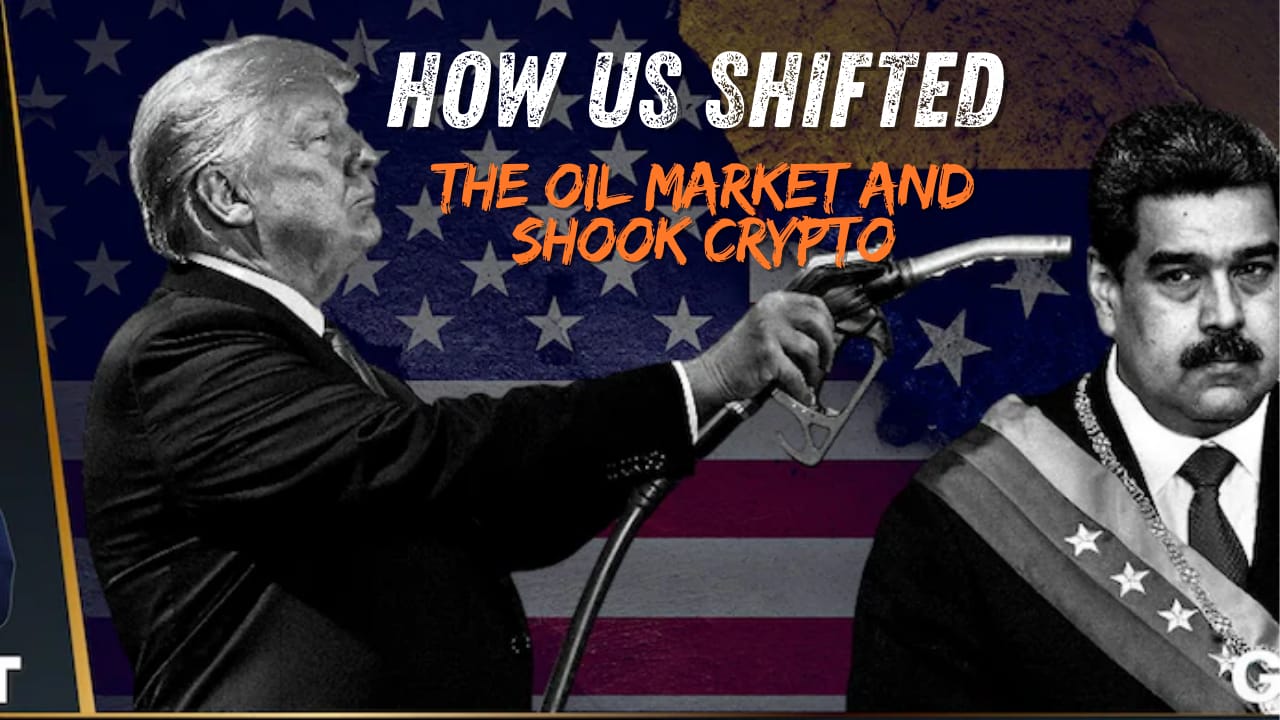
The U.S. acted to remove a geopolitical hub, secure long-term oil influence, and weaken rival power networks without triggering immediate oil market shocks..
TL;DR BOX
The U.S. moved against Venezuela to remove a strategic node, not just a leader. The objective was long-term leverage over oil influence and regional power balance. Venezuela combined massive reserves, weak internal control, and deep ties with China, Russia, and Iran. That made it a pressure point in the global oil market and a security concern in the Western Hemisphere.
The operation ended quickly because the state was already hollow. Lost legitimacy, economic collapse, broken institutions, and an organized opposition left little resistance. For markets, the impact was geopolitical, not immediate. Venezuela cannot restore production fast. Infrastructure is damaged and capital needs are high. Oil prices stayed stable, while US energy stocks moved first on future control expectations.
Key points
-
Fact: Venezuela holds ~303 billion barrels of proven oil reserves.
-
Mistake: Expecting immediate oil supply or price changes.
-
Action: Watch control and capital flows, not headline production.
Critical insight
Markets price future control before physical output ever changes.
Table of Contents
📊 What Actually Happened in Venezuela
What happened in Venezuela wasn’t a coup or a slow-moving regime collapse. It was a decapitation strike.
After weeks of quiet military buildup around the country, U.S. forces executed a short, highly coordinated operation that ended with the capture of Nicolás Maduro. The entire mission reportedly lasted less than three hours.
Air defenses were neutralized first. Then more than 150 U.S. aircraft entered Venezuelan airspace. A Delta Force unit was inserted directly into the military compound where Maduro was staying. Eventually, Maduro and his wife were detained before they could reach a secure room.
Twitter tweet
Okay, first question is why USA do this?
Venezuela as a Key “Geopolitical Node” Venezuela is not a random target. The country possesses a rare combination of strategic elements, making it a geopolitical node with influence extending far beyond its national borders.
First and foremost is oil. Venezuela possesses the world’s largest proven oil reserves, approximately 303 billion barrels. In modern geopolitics, oil is not simply a commodity but a weapon of power, directly impacting inflation, growth, and global political stability.

But more importantly, there is the disparity between reserves and control. Whoever controls the future of this oil resource will hold a tool for long-term influence on the world energy order and structure of the oil market.
The “Historical Wound” Between the US and Venezuela The strained relationship between the US and Venezuela is not new. A structural turning point occurred in 2007, when Hugo Chávez nationalized and seized all assets of American oil and gas companies, including ExxonMobil and ConocoPhillips. This is considered the largest loss of American overseas assets in modern history.

From Washington’s perspective, this was not just an economic dispute, but a direct attack on core interests. Great powers may delay a response, but rarely forget. The Venezuela issue therefore remains on the “unresolved issues” list of US strategy.
Venezuela becomes a bridge between US adversaries. After the US and the West imposed sanctions, Venezuelan oil market redirected to China, where quickly became Venezuela’s leading trading partner, and simultaneously rose to the number one position in much of South America. In 2023, China and Venezuela signed a Comprehensive Strategic Partnership, expanding from oil and gas to mining and technology.

Meanwhile, in November 2024, Venezuela signed 17 major agreements with Russia, ranging from defense, energy, and intelligence to drone technology. Iran also has a presence through security and technical cooperation.

As a result, Venezuela has become a strategic “hub,” connecting the influence networks of China, Russia, and Iran with the entire Latin American region. In network analysis, this is a point with high “betweenness centrality.” Losing this point weakens the entire network.
The US “Pivot Hemisphere” Strategy Under Donald Trump, the US gradually abandoned the Pivot Asia strategy, which had many limitations in containing China in Asia. Instead, Washington shifted to the Pivot Hemisphere strategy, which shifts centers US energy security closer to home. The reason is very practical.
In the Western Hemisphere, the US has an absolute advantage in geography, logistics, and military deployment capabilities. There is no island chain, no strategic buffer zone, and no military peer. Attacking Venezuela’s “backyard” is far more effective than a direct confrontation in East Asia.

In this context, Venezuela becomes a structural weapon. Controlling Venezuela is not just about controlling oil market, but about severing a crucial link in the global rival’s network of influence. At the same time, this action sends a strong signal to other countries in the region such as Cuba, Nicaragua, and Bolivia.
Okay, back to the original point. Do you think arresting a national leader is that easy and quick?
Certainly not. This only works because Venezuela’s system is already hollow.
The tipping point. When all conditions converge The Venezuela event does not stem from a single cause, but is the result of systemic resonance:
-
Loss of Legitimacy: The Maduro government is accused of blatant fraud in the July 2024 elections, causing him to lose international legitimacy.

-
Legal Basis: The US already has a legal basis, albeit fragile, having prosecuted Maduro for drug terrorism since 2020 and officially declared him the leader of a foreign terrorist organization.

-
Internal Decline: Venezuela is a “rotting building.” The economy has collapsed (GDP has fallen by more than 70%, oil production has dropped from 4 million to less than 1 million barrels per day), inflation is high, and a quarter of the population has emigrated. The oil industry is devastated by mismanagement and corruption.

-
Available Alternative Forces: There exists an organized, internationally recognized opposition (such as Edmundo Gonzalez and María Corina Machado) ready to take over after Maduro is overthrown.

It is this internal weakness that caused the military campaign to end in just a few hours without significant resistance.
🏦 What Happens Next?
The message from Washington was immediate and blunt.
Donald Trump said the U.S. plans to “run” Venezuela, with a direct focus on oil. American energy companies are expected to enter, rebuild infrastructure, and restart production, as part of a broader US energy realignment.
Yes, this isn’t humanitarian aid. This is US energy strategy.
Twitter tweet
Former Vice President Delcy Rodríguez was sworn in as acting president. But her position is conditional. Trump openly warned that failure to comply would bring consequences “probably bigger than Maduro.”
At the same time, Washington made its geopolitical red line clear. Russia, China, and Iran are expected to exit without any ambiguity.
Secretary of State Marco Rubio framed it simply: This is the Western Hemisphere – America’s backyard.
Control of US energy corridors is non-negotiable.
What happens next is not an oil price surge tomorrow. Venezuela’s infrastructure is wrecked. Its crude is ultra-heavy, low in quantity, expensive to process, and requires billions in long-cycle investment. Any meaningful production recovery takes years, not quarters.

But control matters more than barrels.
The U.S. didn’t just remove a president. It removed a geopolitical node that connected China, Russia, and Iran to Latin America. From Washington’s perspective, that alone justifies the operation.
You remember our prediction that Bitcoin would return to $80K when the entire market believed BTC would hold $100K and continue moving up.
And we’ve shared high-potential tokens that are positioned for 200% growth in one month, while the broader market looks quiet and sluggish.
This series will be updated more frequently in the PRO edition moving forward.
-
Monthly Plan: Was $29/mo → Now $3.99/mo
-
Annual Plan: Was $199/yr → Now $29/year 🤯
Unlock all PRO signals now 👇
📊 What It Means for Markets?
Many traders entered the weekend expecting a sharp drop in oil prices. The logic was simple: if Venezuela were brought back into the European Union, future supply would increase, and crude oil market prices would fall almost immediately.
However, that didn’t happen.
When the market reopened, WTI crude oil prices briefly declined slightly in response to the news. But this decline quickly disappeared. Prices recovered, rising higher and ultimately trading 1% above Friday’s closing price.

source: Tradingeconomics
The message from the oil market was clear: This event did not significantly alter supply in the short term.
Traders concluded that the overthrow of Maduro did not significantly change the global oil balance. Venezuela’s production capacity had already been severely depleted, and any recovery would take years.
Therefore, the market is viewing this situation as geopolitically significant but irrelevant to current production. Oil market prices are unlikely to be significantly affected for an extended period.
According to Investing.com, speculative positions in crude oil are currently heavily skewed toward short selling. Even before the developments in Venezuela, the volume of short oil orders was at its highest level in about twenty years. In other words, a large portion of the market has bet on lower prices.

With such a one-sided position, the lack of further bearish signals could act as a counter-signal. Despite the negative headlines, crude oil prices remain stable, suggesting a higher potential for a bullish reversal, entirely due to positioning rather than fundamental factors.
However, the long-term picture is different.
If the U.S. ultimately gains control of Venezuela’s oil policy and investment flows, it could create structural obstacles to crude oil prices by the end of this decade.
Twitter tweet
Commodity strategists at Goldman Sachs have pointed out that a gradual recovery in Venezuelan production increases the risk of downside oil prices from 2027 onward. But they also stressed that any recovery would be slow and incomplete, due to the infrastructure and capital required.
Nevertheless, US energy stocks surged. Chevron $CVX ( ▼ 0.86% ) , ConocoPhillips $COP ( ▼ 3.26% ) , and ExxonMobil $XOM.TSX ( ▼ 2.31% ) all recorded sharp gains as investors priced high the prospect of market access, contracts, and future expansion opportunities related to Venezuela. The stock market has outperformed the actual oil market.

source: TradingView
That optimism has attracted investment capital. According to the Financial Times, former Chevron CEO Ali Moshiri is raising $2 billion specifically for oil projects in Venezuela. As he stated, investor interest has surged overnight from virtually nonexistent, highlighting renewed confidence in US energy dominance.
The market may be temporarily overlooking Venezuela’s oil resources. But it’s clear it’s betting on who will control them in the future.
⚠ This newsletter is for informational purposes only and should not be considered investment advice. Traders should conduct thorough research, understand the risks, and carefully evaluate their decisions before investing in cryptocurrency.
If you’re interested in other topics and want to stay ahead of how Crypto is reshaping the markets, from whale strategies to the next major altcoin narrative, you can explore more of our deep-dive articles here:
-
Latest Crypto News: Bitcoin Reawakens, TAO Halving Hype Builds
-
AI in Trading: How ChatGPT Atlas Could Redefine Trading Strategy*
*indicates premium insights available to Pro readers only.
Leave a Reply